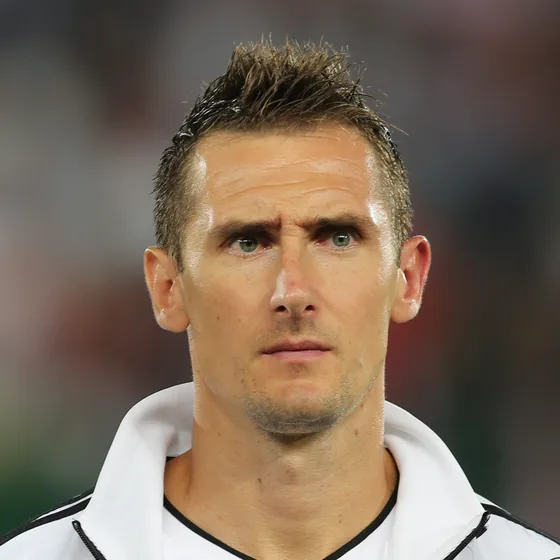

Miroslav Klose scored 16 World Cup goals in 24 matches for Germany, five in 2002, five in 2006, four in 2010 and two in 2014. The sixteenth, against Brazil in Belo Horizonte on 8 July 2014, made him the tournament’s all-time top scorer. He kept that record for almost twelve years. In 2026 it was beaten twice at the same World Cup, first by Lionel Messi, then by Kylian Mbappé, and Klose is now third on the all-time scoring list.
He played four World Cups, 2002, 2006, 2010 and 2014, and came home with a medal from each: silver in 2002, bronze in 2006 and 2010, gold in 2014. FIFA says no other player has won four.
World Cup record by tournament
| Tournament | Age | Played | Goals | Germany’s finish | Scoring list |
|---|---|---|---|---|---|
| 2002, Korea and Japan | 23 | 7 | 5 | Runners-up | Joint second with Rivaldo, behind Ronaldo |
| 2006, Germany | 28 | 7 | 5 | Third | Top scorer (Golden Shoe) |
| 2010, South Africa | 32 | 5 | 4 | Third | One goal behind the four joint top scorers |
| 2014, Brazil | 36 | 5 | 2 | Champions | — |
| Total | 24 | 16 |
Every World Cup match
| Date | Stage | Opponent | Germany’s result | Klose | Goals | Minute of each goal |
|---|---|---|---|---|---|---|
| 1 June 2002 | First round | Saudi Arabia | 8-0 | Started | 3 | 20, 25, 70 |
| 5 June 2002 | First round | Republic of Ireland | 1-1 | Started | 1 | 19 |
| 11 June 2002 | First round | Cameroon | 2-0 | Started | 1 | 79 |
| 15 June 2002 | Round of 16 | Paraguay | 1-0 | Started | 0 | — |
| 21 June 2002 | Quarter-final | United States | 1-0 | Started | 0 | — |
| 25 June 2002 | Semi-final | South Korea | 1-0 | Started | 0 | — |
| 30 June 2002 | Final | Brazil | 0-2 | Started | 0 | — |
| 9 June 2006 | First round | Costa Rica | 4-2 | Started | 2 | 17, 61 |
| 14 June 2006 | First round | Poland | 1-0 | Started | 0 | — |
| 20 June 2006 | First round | Ecuador | 3-0 | Started | 2 | 4, 44 |
| 24 June 2006 | Round of 16 | Sweden | 2-0 | Started | 0 | — |
| 30 June 2006 | Quarter-final | Argentina | 1-1, won 4-2 on penalties | Started | 1 | 80 |
| 4 July 2006 | Semi-final | Italy | 0-2 after extra time | Started | 0 | — |
| 8 July 2006 | Third place | Portugal | 3-1 | Started | 0 | — |
| 13 June 2010 | First round | Australia | 4-0 | Started | 1 | 26 |
| 18 June 2010 | First round | Serbia | 0-1 | Started, sent off 37 | 0 | — |
| 27 June 2010 | Round of 16 | England | 4-1 | Started | 1 | 20 |
| 3 July 2010 | Quarter-final | Argentina | 4-0 | Started | 2 | 68, 89 |
| 7 July 2010 | Semi-final | Spain | 0-1 | Started | 0 | — |
| 21 June 2014 | First round | Ghana | 2-2 | Substitute, on 69 | 1 | 71 |
| 26 June 2014 | First round | United States | 1-0 | Substitute, on 46 | 0 | — |
| 4 July 2014 | Quarter-final | France | 1-0 | Started | 0 | — |
| 8 July 2014 | Semi-final | Brazil | 7-1 | Started | 1 | 23 |
| 13 July 2014 | Final | Argentina | 1-0 after extra time | Started | 0 | — |
How the 16 goals break down
Eleven of the sixteen came in the first round and five in the knockout rounds. He never scored in a final. He played two, the 0-2 against Brazil in Yokohama in 2002, when Ronaldo Nazário scored both goals, and the 1-0 against Argentina in Rio de Janeiro in 2014, when he was replaced by Mario Götze two minutes before the end of normal time. Götze scored the winner in extra time.
Argentina conceded more of his goals than anyone: three, in the 2006 and 2010 quarter-finals. Saudi Arabia conceded three in one afternoon. In 2002, 2006 and 2010 he scored in Germany’s first match. In 2014 he did not play in it.
Germany won 17 of his 24 World Cup matches, drew three and lost four. The draws are Ireland in 2002, Argentina in 2006, which Germany won on penalties, and Ghana in 2014. The four defeats are the 2002 final, the 2006 semi-final against Italy, the 2010 group match against Serbia and the 2010 semi-final against Spain.
2002: five goals, all headers
Klose was 23, and according to FIFA the opening match was only his 13th for Germany. His World Cup debut was the 8-0 against Saudi Arabia at the Sapporo Dome on 1 June: three goals, in the 20th, 25th and 70th minutes, all with his head. He headed the opener against Ireland four days later and the second goal in the 2-0 win over Cameroon. Wikipedia describes him as the first player to score five headers at one World Cup.
Then the goals stopped. Germany beat Paraguay, the United States and South Korea by a goal each, scored by Oliver Neuville once and Michael Ballack twice, and lost the final to Brazil. Klose started all seven matches and finished level with Rivaldo on five, three behind Ronaldo. He received the Silver Shoe.
2006: the Golden Shoe at home
Germany opened their own World Cup against Costa Rica in Munich on 9 June 2006, which was Klose’s 28th birthday. He scored twice in a 4-2 win and was named man of the match. He scored twice more against Ecuador in Berlin, in the 4th and 44th minutes.
His fifth goal came in the quarter-final against Argentina, also in Berlin. Argentina led 1-0 from the 49th minute; Klose equalised in the 80th, and Germany won the shoot-out 4-2. Italy beat them in the semi-final with two goals in the last two minutes of extra time. Five goals were enough for the Golden Shoe. No other player scored more than three at that tournament.
2010: a red card, then three goals in two knockout matches
Klose scored in the first match again, the 4-0 against Australia in Durban. Five days later, against Serbia, he was booked in the 12th minute and again in the 37th, and sent off. Germany lost 1-0. He was suspended for the last group match against Ghana.
He came back for the round of 16 against England in Bloemfontein and opened the scoring after 20 minutes in a 4-1 win. In the quarter-final in Cape Town he scored twice against Argentina, whose coach was Diego Maradona, in another 4-0. That took him to 14 World Cup goals, the same number as Gerd Müller. Spain beat Germany 1-0 in the semi-final, and Klose did not play in the match for third place against Uruguay.
2014: the record, equalled and broken
At 36, Klose was not in the team for Germany’s first match, a 4-0 win over Portugal. Against Ghana in Fortaleza on 21 June, Germany were 2-1 down when he came on in the 69th minute. Two minutes later he scored from close range: 2-2, and his fifteenth World Cup goal, level with Ronaldo Nazário. He came on at half-time against the United States, then sat out the round of 16 against Algeria.
He started the quarter-final against France and the semi-final against Brazil. In Belo Horizonte on 8 July, Germany led 1-0 when Klose’s first shot was saved by Júlio César and he scored from the rebound, in the 23rd minute. It was Germany’s second goal of seven, and his sixteenth at World Cups, one more than Ronaldo. Wikipedia adds another record from that night: he was the first player to appear in four consecutive World Cup semi-finals. He started the final five days later. He retired from international football in August 2014.
How he lost the record in 2026
Messi equalled the 16 with a hat-trick against Algeria in Argentina’s first match of the 2026 World Cup and passed it against Austria. He finished the tournament on 21. Mbappé scored twice in the match for third place against England and finished on 22. Both did it in one tournament, and Klose went from first to third in a month.
The totals hide one difference. Messi needed 34 matches for his goals. Klose played 24, and two of those were short appearances off the bench in 2014. Mbappé needed 22.
Sources and method
RSSSF’s match records for 2002, 2006, 2010 and 2014; FIFA’s match centre for each of the 24 matches; FIFA’s article “Clinical Klose’s medal milestone” (3 June 2024) and its list of all-time leading scorers (19 July 2026); Wikipedia’s pages on Miroslav Klose, 2002 Group E, 2006 Group A, 2010 Group D, 2014 Group G and the knockout stages of all four tournaments.
Appearances, results and scorers were recounted from RSSSF and checked against FIFA and Wikipedia. Only matches at World Cup final tournaments count. A penalty shoot-out counts as a draw. Ages are calculated from his date of birth, 9 June 1978. The rules are in How we verify.
Where the sources disagree
For 2002 and 2006, FIFA’s match centre, Wikipedia and RSSSF give the same minute for every Klose goal. For 2010 and 2014, FIFA’s data feed gives every goal one minute earlier than the other two, and his red card against Serbia at 36 minutes instead of 37. The feed appears to count completed minutes. The match log uses the minutes printed by RSSSF and Wikipedia.
| Goal | FIFA feed | Wikipedia | RSSSF | Used |
|---|---|---|---|---|
| v Australia, 2010 | 25′ | 26′ | 26′ | 26′ |
| v England, 2010 | 19′ | 20′ | 20′ | 20′ |
| v Argentina, 2010 | 67′, 88′ | 68′, 89′ | 68′, 89′ | 68′, 89′ |
| v Ghana, 2014 | 70′ | 71′ | 71′ | 71′ |
| v Brazil, 2014 | 22′ | 23′ | 23′ | 23′ |