
Pelé played in four World Cups, won three of them and scored 12. Those are the numbers everyone knows. The one that almost never gets printed is this: across those four tournaments Brazil played 21 matches, and Pelé played in 14. He missed seven, all of them because of injury.
So this is the Pelé World Cup record as it actually happened, match by match. Two of his four tournaments were full ones, 1958 and 1970. The other two, 1962 and 1966, were cut short, and in one of them Brazil won the trophy without him.
Pelé’s World Cup record by tournament
| Tournament | Age | Brazil played | Pelé played | Goals | Brazil’s finish |
|---|---|---|---|---|---|
| 1958, Sweden | 17 | 6 | 4 | 6 | Champions |
| 1962, Chile | 21 | 6 | 2 | 1 | Champions |
| 1966, England | 25 | 3 | 2 | 1 | First round |
| 1970, Mexico | 29 | 6 | 6 | 4 | Champions |
| Total | 21 | 14 | 12 |
With him on the pitch, Brazil won 12 of the 14, drew one and lost one, 37 goals for and 14 against. The only defeat was Portugal in 1966, a match he could barely walk through. Without him, in the seven matches he missed, Brazil won five, drew one and lost one. That second line is the part the legend usually leaves out, and I think it makes his story better, not smaller.
Every World Cup match Pelé played
| Date | Stage | Opponent | Brazil’s result | Pelé | Goals | Minute of each goal |
|---|---|---|---|---|---|---|
| 15 June 1958 | First round | Soviet Union | 2-0 | Started | 0 | — |
| 19 June 1958 | Quarter-final | Wales | 1-0 | Started | 1 | 66 |
| 24 June 1958 | Semi-final | France | 5-2 | Started | 3 | 52, 64, 75 |
| 29 June 1958 | Final | Sweden | 5-2 | Started | 2 | 55, 90 |
| 30 May 1962 | First round | Mexico | 2-0 | Started | 1 | 73 |
| 2 June 1962 | First round | Czechoslovakia | 0-0 | Started (injured) | 0 | — |
| 12 July 1966 | First round | Bulgaria | 2-0 | Started | 1 | 15 (free kick) |
| 19 July 1966 | First round | Portugal | 1-3 | Started | 0 | — |
| 3 June 1970 | First round | Czechoslovakia | 4-1 | Started | 1 | 59 |
| 7 June 1970 | First round | England | 1-0 | Started | 0 | — |
| 10 June 1970 | First round | Romania | 3-2 | Started | 2 | 19, 67 |
| 14 June 1970 | Quarter-final | Peru | 4-2 | Started | 0 | — |
| 17 June 1970 | Semi-final | Uruguay | 3-1 | Started | 0 | — |
| 21 June 1970 | Final | Italy | 4-1 | Started | 1 | 18 |
He started all 14 and was never substituted. In 1958, 1962 and 1966 substitutes were not allowed at the World Cup at all, which matters for what happened in England.
The seven matches he missed
| Date | Stage | Opponent | Brazil’s result | Why he was missing |
|---|---|---|---|---|
| 8 June 1958 | First round | Austria | 3-0 | Knee injury he arrived with |
| 11 June 1958 | First round | England | 0-0 | Knee injury he arrived with |
| 6 June 1962 | First round | Spain | 2-1 | Injured against Czechoslovakia |
| 10 June 1962 | Quarter-final | England | 3-1 | Injured against Czechoslovakia |
| 13 June 1962 | Semi-final | Chile | 4-2 | Injured against Czechoslovakia |
| 17 June 1962 | Final | Czechoslovakia | 3-1 | Injured against Czechoslovakia |
| 15 July 1966 | First round | Hungary | 1-3 | Injured against Bulgaria |
1958: the 17-year-old who sat out the first two games
Pelé arrived in Sweden with a knee injury and watched the first two games, a 3-0 win over Austria and a 0-0 draw with England. Wikipedia records that a team psychologist told the coach, Vicente Feola, that the 17-year-old was “infantile” and not ready. Feola picked him anyway for the third match, against the Soviet Union. Brazil won 2-0 and Pelé set up a goal. He was, at that point, the youngest player ever to appear at a World Cup.
Then the goals came quickly. Against Wales in the quarter-final he scored the only goal, after 66 minutes, and became the youngest scorer in the tournament’s history. Against France in the semi-final, a France side with Just Fontaine in it, he scored three in the second half. It was the first hat-trick of his international career, and it is on our list of every World Cup hat-trick.
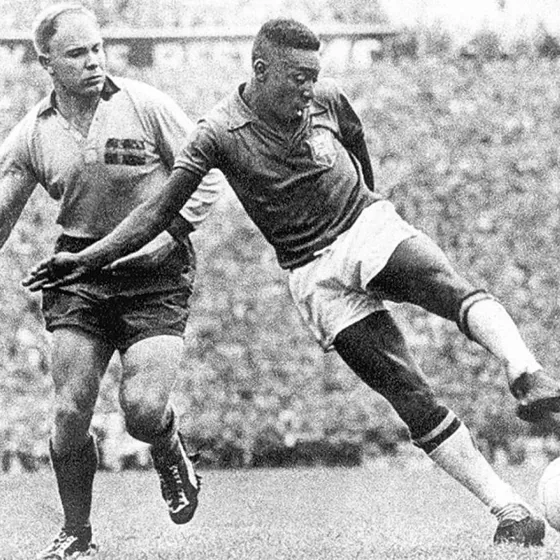
The final against Sweden, on 29 June, finished 5-2. His first goal is the famous one: he flicked the ball over a defender and volleyed it in. His second was a header in the last minute. At the whistle he collapsed on the pitch and cried. Six goals in four matches, named the best young player of the tournament. The Swedish defender Sigvard Parling later said that, when Pelé scored the fifth, he felt like applauding.
One detail I like: he only wore the number 10 because nobody at the Brazilian federation had allocated shirt numbers, and FIFA gave him that one. Wikipedia notes that the shirt from the final was auctioned at Sotheby’s in New York in 2026.
1962: two matches, then Garrincha won it
By 1962 Pelé was considered the best player in the world. In Chile he played the first match against Mexico, set up the opening goal and scored the second, after 73 minutes, for a 2-0 win.
In the next game, against Czechoslovakia, he got injured trying a long-range shot. The match ended 0-0 and he did not play again in the tournament. Brazil won the last four matches without him, against Spain, England, Chile and Czechoslovakia again in the final. The player who carried them was Garrincha, and his page tells that month from the other side.
Here is the odd bit. Only players who appeared in the final got a medal back then, so Pelé went home a champion without one. FIFA changed the rule in 1978 to cover the whole squad, and Pelé finally received a winner’s medal for 1962 in 2007, 45 years late.
1966: kicked out of the tournament
Brazil went to England as double holders. Against Bulgaria, Pelé scored from a free kick after 15 minutes and became the first player to score at three World Cups in a row. He was also fouled over and over, and it cost him the next game. Brazil lost 3-1 to Hungary without him.
He came back, not fully fit, for the last group game against Portugal, which Brazil needed. The Portuguese defender João Morais fouled him twice and stayed on the pitch. Wikipedia describes the referee’s decision as one of the worst in World Cup history. With no substitutes allowed, Pelé limped through the rest of the match. Portugal won 3-1, with two goals from Eusébio, and Brazil went out in the first round. Afterwards Pelé said he would never play at a World Cup again.
Honestly, it is hard to read that and blame him. Two matches, one goal, and a tournament that ended with him being carried along on one leg.
1970: six matches, four goals, six assists
He changed his mind. In 1969 he first refused a call-up, then accepted, and scored six goals in six qualifiers. The side that went to Mexico had Jairzinho, Gérson, Tostão, Rivellino, Clodoaldo and Carlos Alberto, and it is often called the best team there has ever been.
In the first match, a 4-1 win over Czechoslovakia, Pelé scored after 59 minutes and became the second player, after Uwe Seeler, to score at four World Cups. In the same game he nearly scored from the halfway line. Against England he sent a header at goal that Gordon Banks somehow pushed over the bar, the save that still gets called the save of the century. Pelé later joked that he scored more than a thousand goals and people always asked him about the one he did not.
He scored twice against Romania in a 3-2 win. Against Uruguay in the semi-final he did something even stranger: with the goalkeeper Ladislao Mazurkiewicz rushing out, he let the ball run past him on one side, went round him on the other without touching it, then shot just wide. It is one of his most famous moments and it isn’t even a goal.
In the final against Italy at the Azteca, on 21 June, he headed the first goal after 18 minutes. It was Brazil’s 100th goal at the World Cup. He set up the third and the fourth, the last one a pass rolled into the path of Carlos Alberto for what many people consider the best team goal ever scored. Brazil won 4-1. Wikipedia gives him 4 goals and 6 assists for the tournament, and quotes his marker that day, Tarcisio Burgnich, admitting he had told himself Pelé was flesh and bone like everyone else, and had been wrong.
How many World Cup goals did Pelé score?
Twelve, in 14 matches: 6 in 1958, 1 in 1962, 1 in 1966 and 4 in 1970. That still puts him among the top scorers in World Cup history, although several players have since gone past him. He scored in all four tournaments he played, 1958, 1962, 1966 and 1970, and three of his goals came in finals: two in 1958 and one in 1970.
For Brazil in all matches he scored 77 goals in 92 games, a national record that stood for more than fifty years until Neymar passed it in September 2023. His last match for Brazil was against Yugoslavia on 18 July 1971. He died on 29 December 2022, aged 82.
He is one of the players on our player profiles page. If you only take one thing from Pelé’s World Cup record, take the 14 out of 21: three titles, won by a man who was missing for a third of the matches.
Sources and method
RSSSF’s match records for 1958, 1962, 1966 and 1970; FIFA’s match centre for all 21 Brazil matches at those four tournaments; Wikipedia’s page on Pelé and its match reports for each tournament.
Appearances, results and scorers were recounted from RSSSF and checked against FIFA and Wikipedia. Only matches at World Cup final tournaments count; qualifiers do not. Ages are calculated from his date of birth, 23 October 1940. The rules are in How we verify.
Where the sources disagree
The three sources agree on every match, result and scorer, and on all 12 goals. FIFA and Wikipedia give the same minute for every goal listed below; RSSSF differs on seven of them, by up to seven minutes for the goal against Wales.
| Goal | FIFA | Wikipedia | RSSSF | Used |
|---|---|---|---|---|
| v Wales, 1958 | 66′ | 66′ | 73′ | 66′ |
| v France, 1958 | 52′, 64′, 75′ | 52′, 64′, 75′ | 53′, 64′, 76′ | 52′, 64′, 75′ |
| v Bulgaria, 1966 | 15′ | 15′ | 14′ | 15′ |
| v Czechoslovakia, 1970 | 59′ | 59′ | 60′ | 59′ |
| v Romania, 1970 | 19′, 67′ | 19′, 67′ | 20′, 66′ | 19′, 67′ |